.gt-brush-guide{max-width:900px;margin:0 auto;color:#303537;font-family:Arial,Helvetica,sans-serif;font-size:17px;line-height:1.72}.gt-brush-guide *{box-sizing:border-box}.gt-brush-guide h2,.gt-brush-guide h3{color:#264c49;line-height:1.3}.gt-brush-guide h2{margin:2em 0 .7em;font-size:clamp(1.45rem,3vw,1.9rem)}.gt-brush-guide h3{margin:1.35em 0 .5em;font-size:1.2rem}.gt-brush-guide p{margin:0 0 1.1em}.gt-brush-guide ul,.gt-brush-guide ol{margin:0 0 1.3em;padding-left:1.35em}.gt-brush-guide li{margin-bottom:.45em}.gt-brush-guide a{color:#275b56;text-decoration:underline;text-underline-offset:3px}.gt-brush-guide .gt-lead{padding:1.5rem;border-radius:18px;background:linear-gradient(135deg,#214844,#3f7972);color:#fff;font-size:1.08rem}.gt-brush-guide .gt-lead p:last-child{margin-bottom:0}.gt-brush-guide .gt-note,.gt-brush-guide .gt-warning{margin:1.35em 0;padding:1.1rem 1.2rem;border-radius:14px}.gt-brush-guide .gt-note{border-left:5px solid #3f7b74;background:#edf8f5}.gt-brush-guide .gt-warning{border-left:5px solid #985765;background:#fff1f3}.gt-brush-guide .gt-note p:last-child,.gt-brush-guide .gt-warning p:last-child{margin-bottom:0}.gt-brush-guide .gt-grid{display:grid;grid-template-columns:repeat(2,minmax(0,1fr));gap:1rem;margin:1.3em 0}.gt-brush-guide .gt-card{padding:1.1rem;border:1px solid #dce8e5;border-radius:15px;background:#fff}.gt-brush-guide .gt-card h3{margin-top:0}.gt-brush-guide .gt-card p:last-child,.gt-brush-guide .gt-card ul:last-child{margin-bottom:0}.gt-brush-guide .gt-table-wrap{margin:1.4em 0;overflow-x:auto;border:1px solid #dce8e5;border-radius:15px}.gt-brush-guide table{width:100%;min-width:720px;border-collapse:collapse;font-size:.93rem}.gt-brush-guide th,.gt-brush-guide td{padding:.9rem;border-bottom:1px solid #dce8e5;text-align:left;vertical-align:top}.gt-brush-guide th{background:#275b56;color:#fff}.gt-brush-guide tbody tr:nth-child(even){background:#f7fbfa}.gt-brush-guide tbody tr:last-child td{border-bottom:0}.gt-brush-guide .gt-steps{counter-reset:step;list-style:none;padding:0}.gt-brush-guide .gt-steps>li{position:relative;margin:0 0 1rem;padding:1rem 1rem 1rem 3.25rem;border:1px solid #dce8e5;border-radius:14px;background:#fbfefd;counter-increment:step}.gt-brush-guide .gt-steps>li:before{content:counter(step);position:absolute;left:1rem;top:1rem;width:1.65rem;height:1.65rem;display:flex;align-items:center;justify-content:center;border-radius:50%;background:#275b56;color:#fff;font-weight:700;font-size:.85rem}.gt-brush-guide .gt-steps strong{color:#264c49}.gt-brush-guide details{margin-bottom:.75rem;border:1px solid #dce8e5;border-radius:12px;background:#fff}.gt-brush-guide summary{padding:1rem;color:#264c49;font-weight:700;cursor:pointer}.gt-brush-guide details p{padding:0 1rem 1rem;margin:0}.gt-brush-guide .gt-sources{margin-top:2em;padding:1.2rem;border-top:3px solid #3f7b74;background:#f4f8f7;font-size:.9rem}.gt-brush-guide .gt-sources h2{margin-top:0}.gt-brush-guide .gt-sources li{overflow-wrap:anywhere}@media(max-width:680px){.gt-brush-guide{font-size:16px}.gt-brush-guide .gt-grid{grid-template-columns:1fr}}
Cleaning a personal powder brush and reprocessing a brush used across paying clients are not the same task. Personal tools mainly need regular residue removal and complete drying. Multi-client work also requires controls that keep used tools away from clean supplies and comply with the rules where the service takes place.
This guide explains the practical workflow, where quick brush cleaners fit, and why a generic instruction to spray every brush with 70% alcohol is not a reliable universal protocol.
How this guidance was assembled
This is a source-based hygiene guide, not the result of microbiological testing, salon audits or hands-on comparisons of brush cleaners. It draws on published guidance from the American Academy of Dermatology, the FDA, the CDC, the EPA and professional-service regulators. Those sources do not create one worldwide makeup-brush standard, so professionals must also check their local licensing, workplace and public-health requirements.
The central distinction: washing removes makeup, oil and other soil. Disinfection is a separate, label-directed process that may be required in some professional settings. Applying disinfectant to a visibly dirty brush does not replace cleaning.
Cleaning, sanitizing and disinfecting are different
Cleaning
Water, cleanser and mechanical action remove cosmetic residue, skin oil and many microorganisms. This is the essential first step for a washable brush.
Sanitizing
This means reducing microorganisms to a level defined by a public-health code or standard. Beauty advice often uses the word casually, but its regulatory meaning can be more specific.
Disinfecting
A suitable chemical process kills specified microorganisms when the product is applied to an allowed surface or item for the required contact time. The exact label matters.
Sterilizing
Sterilization is a validated process that destroys all forms of microbial life. Routine washing, alcohol mist and an unvalidated consumer UV box should not be described as sterilizing makeup brushes.
The CDC’s cleaning and disinfecting definitions are useful for understanding the terms, but they are general hygiene guidance rather than a makeup-brush procedure. Local personal-service rules and the instructions for the brush and chemical product determine what is appropriate in a professional setting.
Choose the routine by how the brush is used
| Situation | Practical action | What to verify |
|---|---|---|
| Personal brush used by one person | Wash regularly with a compatible cleanser, rinse thoroughly and dry flat. | Fiber-care instructions and whether product remains in the center of the brush. |
| Personal brush used with cream or liquid makeup | Clean whenever buildup develops rather than relying only on a calendar. | Dense inner bristles are free of oily or tinted residue. |
| Brush that touched a professional client | Move it directly to the used-tool container. Do not return it to clean stock until it has completed the required process. | Local rules, workplace procedure and any product-label requirements. |
| Quick color change on the same client | Use a fast-drying cleaner only if its label supports that use, then allow the brush to dry before touching the same client again. | The cleaner’s purpose and fiber compatibility. This does not automatically prepare the brush for another client. |
| Single-use wand or applicator | Use once and discard immediately. | Never reinsert a used disposable applicator into the original cosmetic. |
| Possible infection, blood or broken-skin exposure | Stop using the item, isolate it and follow the applicable exposure procedure. | Whether the brush and exposed cosmetics can be validly reprocessed or must be discarded. |
For personal brushes, the American Academy of Dermatology recommends washing approximately every seven to ten days. That is a useful baseline, not a reason to wait when a brush has obvious buildup, has been shared or was used near irritated or infected skin.
For multi-client work, treating every brush that touched a client as used is a straightforward way to prevent mix-ups. Carrying multiple clean sets is more dependable than expecting one washed brush to dry before the next appointment.
A step-by-step washing workflow
- Separate clean, used and disposable items. Put every used brush in a clearly identified, cleanable container. Keep fresh brushes, palettes and cosmetics outside the washing and splash area.
- Inspect the brush. Check for a loose ferrule, split or swollen handle, rust, persistent odor, cracked coatings, heavy shedding or product that cannot be removed from the center. Retire a brush that cannot be cleaned or dried reliably.
- Remove loose product. Gently wipe excess powder or cream onto a disposable towel. This reduces residue but is not a substitute for washing.
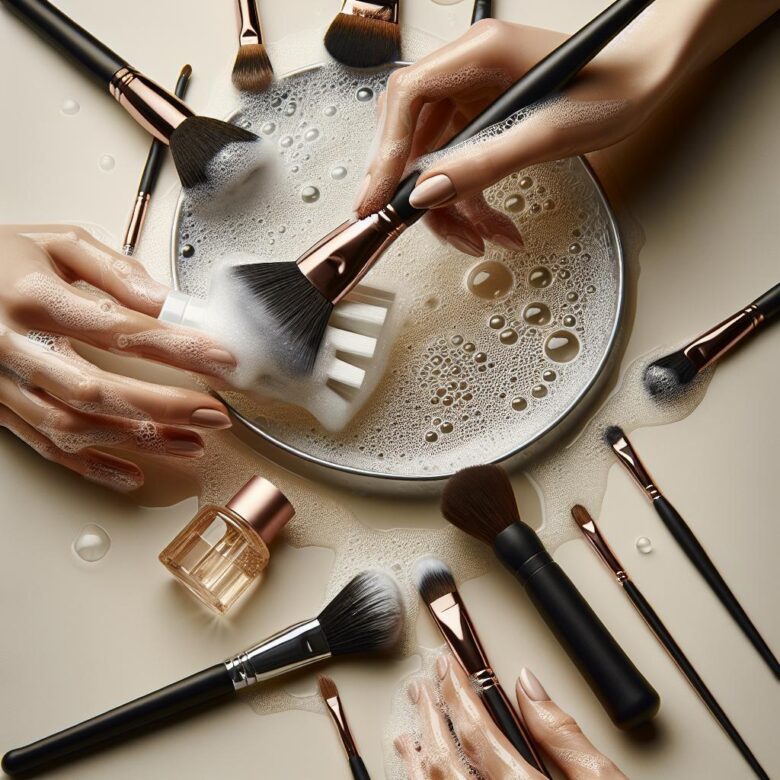
- Wet the bristles with lukewarm water. Point the bristles downward or sideways so water runs away from the ferrule. Avoid soaking the full brush unless its manufacturer expressly permits it.
- Apply a compatible cleanser. A dedicated brush cleanser or gentle shampoo may be suitable, depending on the fibers and residue. Follow the cleanser’s directions instead of creating an improvised chemical mixture.
- Work through the complete brush head. Massage gently with clean fingers or light pressure on a clean textured mat. Dense foundation and concealer brushes need attention in the center and near the base, not only at the visible tips.
- Rinse thoroughly. Continue until no lather, oil or color remains. Repeat the cleanser step rather than scrubbing harder if makeup is still present.
- Blot and reshape. Press the bristles in a clean paper towel or lint-free material without twisting or pulling. Return the damp brush head to its normal profile.
- Complete any additional process required for professional use. If local rules call for sanitizing or disinfecting, use only a procedure supported by the exact product label, intended material and applicable regulation.
- Dry flat and store only when fully dry. Lay the brush horizontally with the bristles exposed to airflow. Check the inner fibers near the ferrule before placing the brush in a clean, covered container.
Avoid high heat and closed storage while damp. A hair dryer, radiator or hot water can affect fibers, finishes or adhesive. A damp brush sealed in a roll may develop odor or material damage even when its tips initially feel dry.
How to choose a cleanser
Dedicated brush cleanser
This is a practical option when its label covers the type of fiber being washed. Look for clear use and rinsing directions rather than relying on claims such as “professional strength.” A cleanser that removes makeup is not necessarily a disinfectant.
Gentle shampoo
The American Academy of Dermatology includes gentle shampoo in its personal brush-cleaning guidance. Before using it on a professional kit, check the brush manufacturer’s care instructions and determine whether local rules require a separate process.
Fast-drying brush cleaner
A solvent-based or fast-evaporating cleaner may help remove eyeshadow pigment during one person’s application. It should not be assumed to remove every type of residue or meet a jurisdiction’s disinfection requirement. Follow its stated purpose, ventilation directions and material warnings.
Natural and synthetic fibers, painted handles and different adhesives may not tolerate the same cleanser. If care instructions are unavailable, test compatibility cautiously on a nonessential tool rather than exposing an entire kit to an aggressive solvent or prolonged soaking.
Why 70% alcohol is not a universal answer
An alcohol concentration by itself does not establish that a particular spray will disinfect a dense makeup brush. Effectiveness depends on factors that include the exact formulation, permitted use, application method, contact time, amount of visible soil and compatibility with the item.
- Clean visible makeup and oil first.
- Read the complete label rather than relying on the active ingredient alone.
- Confirm that the stated surface, material or use includes the intended application.
- Apply the product by the labeled method and maintain any required wet or contact time.
- Follow ventilation, rinsing and protective-equipment directions.
- Do not decant chemicals into an unlabeled bottle.
- Never combine alcohol, bleach, ammonia or other cleaning chemicals.
- Allow the brush to dry fully before use.
The EPA explains how to select registered disinfectants and cautions against using an application method not included in the directions. Many disinfectants are intended for specified hard, nonporous surfaces; registration for a countertop does not automatically make a product suitable for porous bristles, adhesive or a wooden handle.
A workable multi-client setup
Clean zone
- Processed, completely dry brush sets
- Fresh single-use applicators
- Clean palettes and spatulas
- Closed cosmetic products
- Covered or closed transport storage
Used and waste zones
- A labeled container for every used reusable tool
- A separate receptacle for single-use applicators
- No clean brushes or open cosmetics
- Secure storage during transport
- A process for cleaning reusable containers
The setup should make a brush’s status obvious without relying on memory. Once a brush touches a client, it stays out of the clean zone even if it was used only briefly.
Protect products from the used brush
- Dispense liquids and creams onto a clean palette with a clean spatula.
- Do not double-dip a used brush into a jar, pan or liquid product.
- Do not return unused palette product to its original container.
- Use a fresh disposable wand each time product is taken from shared mascara or lip packaging.
- Keep bottle openings, pump tops and caps from touching used tools.
- Follow local procedures for pencils and pressed powders.
The FDA advises against sharing makeup because products and applicators can carry microorganisms. For professional work, decanting and single-use applicators reduce the chance that a used brush will contaminate product reserved for later clients.
Reusable sponges present a different challenge because their interior is difficult to inspect and may dry slowly. Check local rules and manufacturer instructions before using one across clients. Glow Theory’s comparison of makeup sponges explains other construction and replacement considerations.
When to stop and isolate a tool
Do not treat contact with blood, broken skin, eye discharge or a suspected infection as ordinary makeup residue. Stop the service in the affected area, isolate exposed reusable tools and cosmetics, discard contaminated single-use items and follow the relevant workplace and public-health procedure.
The FDA’s eye cosmetic safety guidance advises stopping eye-cosmetic use during an infection and discarding products used when the infection occurred. A brush or cosmetic that cannot undergo the required process without damage should not return to professional service.
Inspect before the brush returns to the kit
- Residue: No visible pigment, oil, debris or cleanser remains in the outer or inner bristles.
- Dryness: The center of the brush feels dry, not merely the exposed tips.
- Structure: The ferrule, handle and coating are secure and free of cracks, swelling, rust or peeling.
- Fiber condition: The brush returns to its intended shape without persistent stiffness, sharpness, odor or unusual shedding.
- Storage: The brush roll or container is clean, dry and has not carried unprocessed tools.
If a damaged brush needs replacing, the guide to choosing makeup brushes explains useful shapes and which tools are necessary for a basic kit.
Frequently asked questions
How often should personal makeup brushes be washed?
The American Academy of Dermatology recommends approximately every seven to ten days. Wash sooner when there is obvious cream, oil or pigment buildup, and do not share brushes with another person.
Can a quick brush-cleaner spray replace washing?
Not automatically. It may remove pigment for a color change on the same client if its label supports that use. It does not necessarily remove buildup from the center of a dense brush or satisfy professional reprocessing rules.
Does soap and water disinfect a brush?
Washing removes residue and many microorganisms, but cleaning and regulated disinfection are different processes. Whether an additional step is required depends on the professional rules that apply where the service is performed.
Can a salon disinfectant be used to soak makeup brushes?
Only if the exact product directions, brush-care instructions and local regulations support that material and method. Do not assume a disinfectant labeled for hard, nonporous salon tools is appropriate for bristles, adhesive and wooden handles.
Can a consumer UV box sterilize brushes?
UV exposure does not remove foundation, oil or other debris. Do not call a device a sterilizer or use it instead of washing unless it has a validated process for that exact item and intended use.
A concise routine to follow
For personal brushes, wash regularly with a compatible cleanser, rinse completely, reshape and dry flat. For professional work, add a system that separates clean and used tools, prevents double-dipping, provides enough brush sets for the client schedule and follows applicable reprocessing rules.
Before using any disinfectant, verify four things: the exact product label, the material it may be used on, the required application and contact time, and the regulation governing the service location. An improvised alcohol recipe cannot answer those questions.
Editorial basis and official references
Glow Theory did not conduct laboratory testing, salon inspections or client sanitation trials for this guide. Requirements vary by location, and this article does not replace instructions from a licensing body, public-health authority, employer or product manufacturer.
- American Academy of Dermatology — How to clean makeup brushes
- U.S. FDA — Using cosmetics safely
- U.S. FDA — Eye cosmetic safety
- U.S. FDA — Microbiological safety and cosmetics
- Public Health Ontario — Infection prevention in personal service settings
- California Board of Barbering and Cosmetology — Health and safety regulations
- U.S. CDC — Cleaning, sanitizing and disinfecting definitions
- U.S. CDC — Cleaning before disinfection and contact time
- U.S. EPA — Selecting and using registered disinfectants
- U.S. EPA — Following the labeled application method

Glow Theory publishes research-based makeup and beauty guidance. Product comparisons distinguish documented specifications and source-based research from hands-on testing. The publication does not present manufacturer claims as independent test results and does not claim professional or medical credentials that have not been verified.